> For the complete documentation index, see [llms.txt](https://docs.ddosify.com/llms.txt). Markdown versions of documentation pages are available by appending `.md` to page URLs; this page is available as [Markdown](https://docs.ddosify.com/ddosify/getting-started/dashboard.md).

# Dashboard

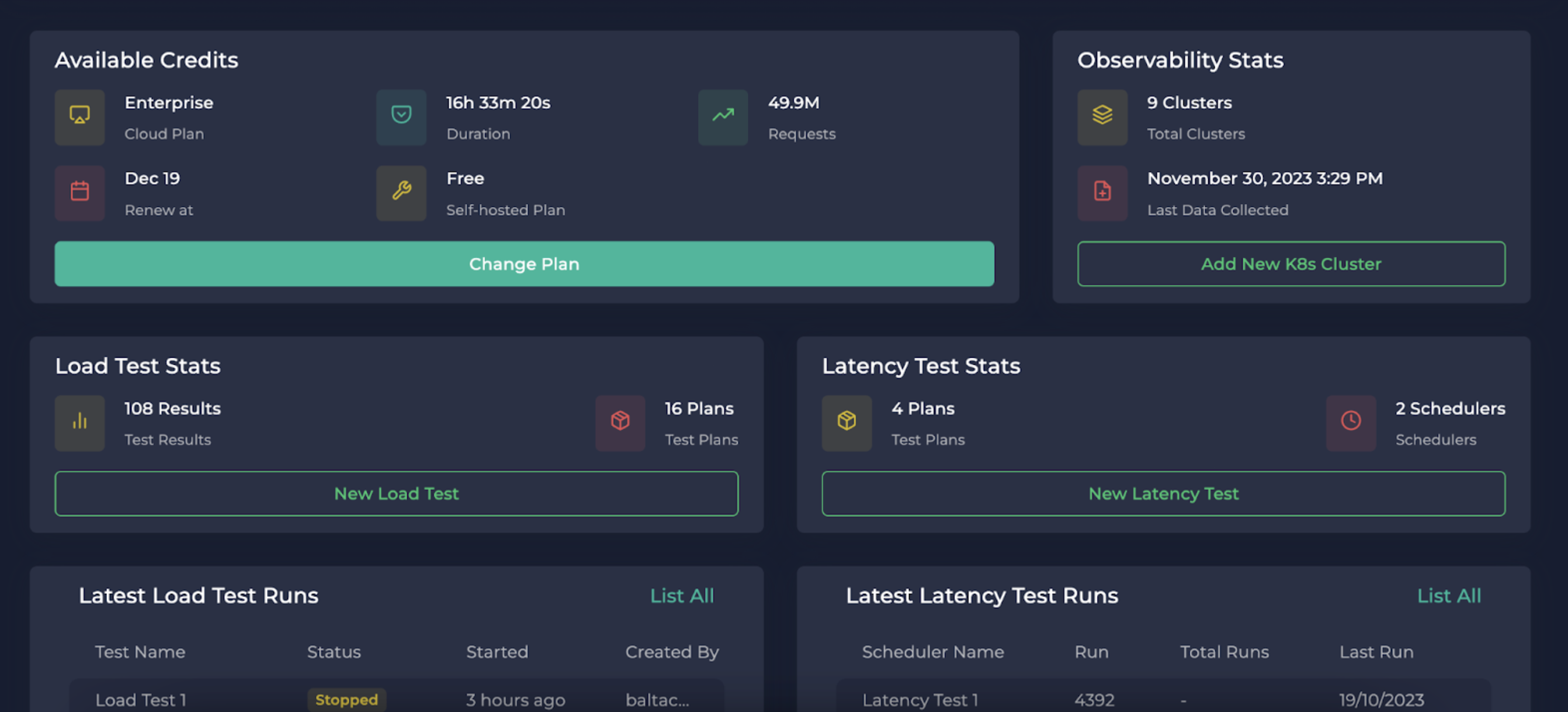
The first page that welcomes you after logging in is the dashboard. Here, you can think of this page as a summary of your account. Through the dashboard, you can view your observability summary, latest load/latency tests, subscription status etc.

<figure><img src="/files/6GGkJcnqcd0fECb7ePyx" alt=""><figcaption><p>Dashboard</p></figcaption></figure>

There are 7 sections in the dashboard:

* Available Credits
* Observability Stats
* Load Test Stats
* Latency Test Stats
* Latest Load Test Runs
* Latest Latency Test Runs
* Usage Report

### Available Credits

<figure><img src="https://lh7-us.googleusercontent.com/seA8ItCCD4O2wfZDr0TTFt3H-zHh_lxUwJQYRZa_ai_JXEc2i1ABSWkj5eWL4-a7nwbh20JKlIm-eYS6mIRW0SCLbA2B-Xi6mBT4TjL7dHAtl0yxSEXRVX6lSQkaSmkDYUq1-V_OCSJmgdgzR5LP3c4" alt=""><figcaption><p>Available Credits</p></figcaption></figure>

Here, information about your plan and subscription status is written. Your Cloud and Self-Hosted plans differ and thus they are represented separately. You can also use the button below to change your subscription plan.

### Observability Stats

<figure><img src="https://lh7-us.googleusercontent.com/UxfgG9F8fboH0rjww1igVg7XNIhHvP4Rpb12REAm5ZEV2S0UAdcWuQP0Wo2-uCW9-oMVdDU3YDCKmKxdL4Gep4Zo2TGeo5bo8Raa9xcL2JSq8zB1Fd0HAdkvaCC8aEMDd_SoDphKAg56JpouDAMY-iQ" alt="" width="375"><figcaption><p>Observability Stats</p></figcaption></figure>

Here, you can view the number of clusters you’ve created and the latest data collected from any of them. You can also use the button below to create a new cluster.

### Load Test Stats

<figure><img src="https://lh7-us.googleusercontent.com/ylLhsTYE6InijwSc_BAgxTSdklDAiozIfgIAv9lXfnq1UDQhmEx85xsT_DKUhepmpXHLZJAqhLGdmYf3_syAsvH9KBHgdQYn--GM_Q58vpXNXxYhpvodl06sPep3jJ33GXe_2UFmjJqzzYB0Yda5gjI" alt="" width="563"><figcaption><p>Load Test Stats</p></figcaption></figure>

Here, you can view the total number of load test results and the number of test plans you have. You can also use the button below to create a new load test.

### Latency Test Stats

<figure><img src="https://lh7-us.googleusercontent.com/bgXNSFnK9ERuA5yMxkpdDX1sdo4sexxYycQEkh7Ork2tC-X3I_ccMUkmtAgDsfyECRW-zUqMShPL_34NSgZexV-TCQlnEJTJQEfva9Yw_0FExaaWpBkaTmHZT57I5CqN4reQVeFZqivzbsSlo_SgmwU" alt="" width="563"><figcaption><p>Latency Test Stats</p></figcaption></figure>

Here, you can view the total number of latency test plans and the number of schedulers you have. Schedulers are based on these test plans and they are designed to run regularly. You can also use the button below to create a new latency test.

### Latest Load Test Runs

<figure><img src="https://lh7-us.googleusercontent.com/yEkov9BigAyQD-fbe8CrU7ph3Fy1f6NKDTONK_9Rb-Z5mEdM1F8F0rc5wtgI6KO8KuGC7YUjvYtVd73mgq2QrJST8LVvXrHm-0VikNPT9bDfNkzXGBX8M6p76Bsc3Z82yIl3VI1QJeX3K0OwqrdDlVQ" alt="" width="563"><figcaption><p>Latency Load Test Runs</p></figcaption></figure>

Here, you can view your latest 5 load tests and their status. You can also click on the “List All” button to view all of your load test results.

### Latest Latency Test Runs

<figure><img src="https://lh7-us.googleusercontent.com/L7iI4B32cdllVTkrkoWVTI6i0-1O_zoAImuFQy2EjxVhmDMNgI8TOhOqI7WTWAI8hXYWtsHs4_UdiJcYFONRz6tFEhD8WmUf9y9Vc2VSR-zumOdSiBuz_F2_ICvl8PhoZ4cFvpiVWRMiq3mV8eNy31M" alt="" width="563"><figcaption><p>Latest Latency Test Runs</p></figcaption></figure>

Here, you can view your latest 5 latency tests and their run counts along with the last run timestamp. You can also click on the “List All” button to view all of your latency test schedulers.

### Usage Report

<figure><img src="https://lh7-us.googleusercontent.com/e2_OQ-LTTOcGSAhNMHbwCjj6NuyqvlyGUPL9nv3kJMi9bABsRYeHtvaBB-PfEc1Up5Pzr6pL332yD18Y_lWgzY0N5iMqh0es4xGt9tNuY39AfZ4yq6wbDTxlVVBu8FHMJFgiB2OZQEnJ7EVTWib63JA" alt=""><figcaption><p>Usage Report</p></figcaption></figure>

Here, you can view your request count and duration usage summary for the last 30 days. You can see more details if you hover on the data:
<figure><img src="https://lh7-us.googleusercontent.com/XEXzIUIDMzwkl8S7liRLlA2n8sdxhejsb4tSdbdjOrKg5HSbDt-L0nqDZHusfvD5SXgI9E_FsLi2h2Q7RAxMuVPoKvps31Cgzam4sMoA8zUwNEMZdZyPyAoQZPZlyAc3qBpQfaHk-vhoraJpf6S-mY0" alt=""><figcaption><p>Hovering on the usage report</p></figcaption></figure>


---

# Agent Instructions
This documentation is published with GitBook. GitBook is the documentation platform designed so that both humans and AI agents can read, navigate, and reason over technical content effectively. Learn more at gitbook.com.

## Querying This Documentation
If you need additional information that is not directly available in this page, you can query the documentation dynamically by asking a question.

Perform an HTTP GET request on the current page URL with the `ask` query parameter, and the optional `goal` query parameter:

```
GET https://docs.ddosify.com/ddosify/getting-started/dashboard.md?ask=<question>&goal=<endgoal>
```

`ask` is the immediate question: it should be specific, self-contained, and written in natural language.
`goal` is optional and describes the broader end goal you are ultimately trying to accomplish on behalf of the user. GitBook uses it to tailor the answer towards what is most useful for that goal.

The response will contain a direct answer to the question and relevant excerpts and sources from the documentation.

Use this mechanism when the answer is not explicitly present in the current page, you need clarification or additional context, or you want to retrieve related documentation sections.
