> For the complete documentation index, see [llms.txt](https://docs.ddosify.com/llms.txt). Markdown versions of documentation pages are available by appending `.md` to page URLs; this page is available as [Markdown](https://docs.ddosify.com/ddosify/deployment.md).

# Deployment

There are various deployment options for:

* 🏠 [Ddosify Self-hosted](#ddosify-self-hosted)
* 🚀 [Ddosify Engine](#ddosify-engine)
* 🐝 [Ddosify eBPF Agent (Alaz)](#ddosify-ebpf-agent-alaz)
* ☁️ [Ddosify Cloud](#ddosify-cloud) <- *If you need a complete SaaS solution*

### 🏠 Ddosify Self-hosted

<figure><img src="/files/JwCLF2ufvs7nxwt2r3Ra" alt=""><figcaption><p>Ddosify automatically generates a Service Map of your K8s cluster without code instrumentation or sidecars. So you can easily find the bottlenecks in your system. Red lines indicate the high latency between services.</p></figcaption></figure>

If you need a web-based user interface with **Performance Testing**, and **Kubernetes Monitoring** capabilities and want to maintain it on your own, Ddosify Self-hosted is the right choice for you.

Check out the [Ddosify Self-hosted](https://github.com/ddosify/ddosify/tree/master/selfhosted) guide for reference. You can also deploy Ddosify Self-hosted on [AWS Marketplace](https://aws.amazon.com/marketplace/pp/prodview-mwvnujtgjedjy).

### 🚀 Ddosify Engine

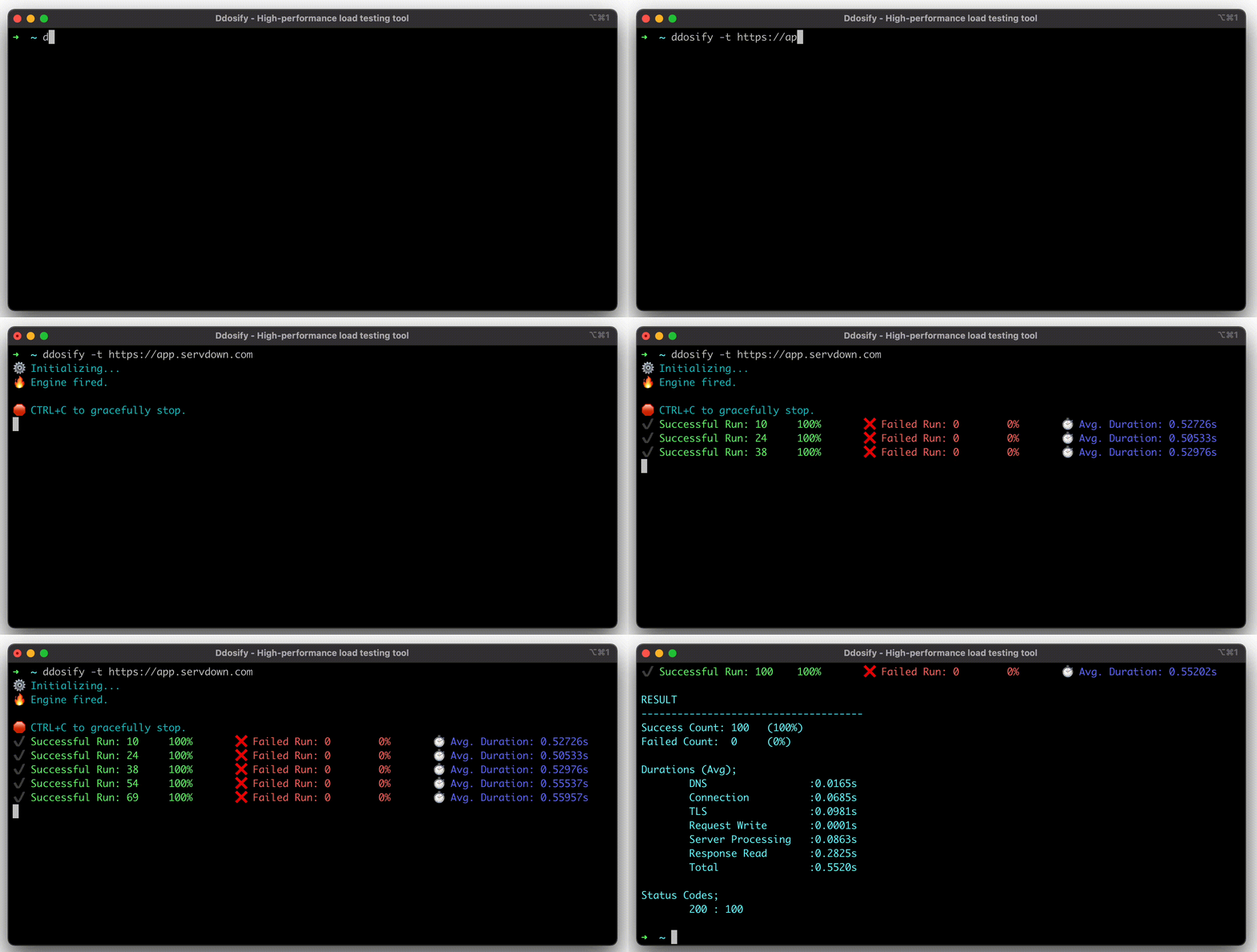
<figure><img src="/files/MGRXL2ExPeN7LPG1ZvQ2" alt=""><figcaption><p>With Ddosify Engine you can simulate and load test your endpoints on your terminal without writing code.</p></figcaption></figure>

If you need CLI-based load testing tool, [Ddosify Engine](https://github.com/ddosify/ddosify/tree/master/engine_docs) is an open-source and high-performance load testing tool, written in Golang.&#x20;

Check out the [Ddosify Engine Installation](https://github.com/ddosify/ddosify/tree/master/engine_docs#installation) guide for reference.&#x20;

### 🐝 Ddosify eBPF Agent (Alaz)

If you use Kubernetes Monitoring either on Ddosify Cloud or Ddosify Self-hosted, the Ddosify eBPF Agent (Alaz) must be installed as a Daemonset on your Kubernetes cluster. The system resources are limited to 1 CPU core and 1Gi Memory per K8s node, so it it very lightweight.

Check out the [Alaz GitHub](https://github.com/ddosify/alaz) repository for reference.&#x20;

### ☁️ Ddosify Cloud

If you need a complete SaaS solution for Performance Testing **worldwide** and Kubernetes Monitoring and do not want to manage the services, Ddosify Cloud is the right choice.&#x20;

Check out the [Ddosify Cloud](https://app.ddosify.com/) guide for reference.

{% hint style="success" %}
If you require assistance with deploying Ddosify, you can join our [Discord](https://discord.com/invite/9KdnrSUZQg) or send an email to <support@ddosify.com>.
{% endhint %}


---

# Agent Instructions
This documentation is published with GitBook. GitBook is the documentation platform designed so that both humans and AI agents can read, navigate, and reason over technical content effectively. Learn more at gitbook.com.

## Querying This Documentation
If you need additional information that is not directly available in this page, you can query the documentation dynamically by asking a question.

Perform an HTTP GET request on the current page URL with the `ask` query parameter, and the optional `goal` query parameter:

```
GET https://docs.ddosify.com/ddosify/deployment.md?ask=<question>&goal=<endgoal>
```

`ask` is the immediate question: it should be specific, self-contained, and written in natural language.
`goal` is optional and describes the broader end goal you are ultimately trying to accomplish on behalf of the user. GitBook uses it to tailor the answer towards what is most useful for that goal.

The response will contain a direct answer to the question and relevant excerpts and sources from the documentation.

Use this mechanism when the answer is not explicitly present in the current page, you need clarification or additional context, or you want to retrieve related documentation sections.