> For the complete documentation index, see [llms.txt](https://docs.ddosify.com/llms.txt). Markdown versions of documentation pages are available by appending `.md` to page URLs; this page is available as [Markdown](https://docs.ddosify.com/ddosify/kubernetes-monitoring/install-ebpf-agent-alaz.md).
# Install eBPF Agent (Alaz)
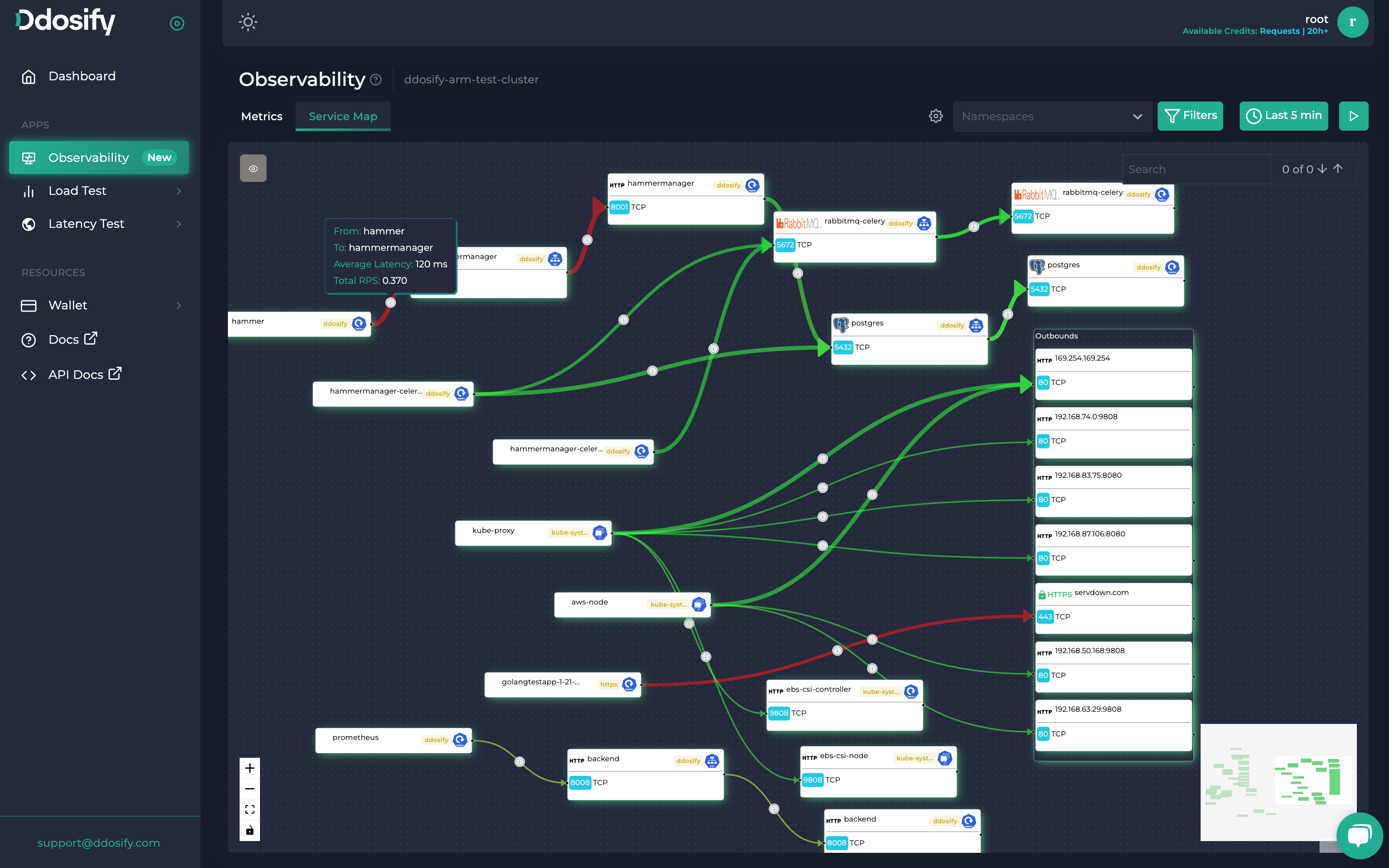
To start monitoring your Kubernetes Cluster, you need to create a new Cluster on the Ddosify platform. To achieve this, navigate to the [Clusters page](https://app.ddosify.com/clusters) and click the Add Cluster button. After providing a unique name for the Cluster, you will be navigated to the Observability page, where you will see the [Service Map](/ddosify/kubernetes-monitoring/service-map.md), [Metrics Dashboard](/ddosify/kubernetes-monitoring/metrics.md), and [Distributed Tracing](/ddosify/kubernetes-monitoring/distributed-tracing.md) for this Cluster.
But before that, you have to install and run our [open-source eBPF agent (Alaz)](https://github.com/ddosify/alaz) as a DaemonSet in your Kubernetes Cluster. Follow the below instructions to set up a new cluster successfully.
{% hint style="info" %}
Installing Alaz on Ddosify Self-Hosted requires some extra steps. For that case, please refer [here](https://app.gitbook.com/o/jN3rtZ38DU58INyTNPm7/s/ugegoRCn84wtxrIelgft/~/changes/115/ddosify/self-hosted/install-ebpf-agent-alaz-on-self-hosted).
{% endhint %}
1. Click the Set Up Cluster button
2. A pop-up will open and show you how to install Alaz via Kubectl or Helm:
#### Kubectl
Kubectl instructions
This installs Alaz as a DaemonSet in your cluster. Let's see what each line does:
```
# Deploy Alaz with Kubectl
1. MONITORING_ID=0ce2ef05-ef64-459d-90d9-7f2cbd65fff8
2. curl -sSL https://raw.githubusercontent.com/ddosify/alaz/master/resources/alaz.yaml -o alaz.yaml
3. sed -i"" -e "s//$MONITORING_ID/g" alaz.yaml
4. kubectl create namespace ddosify
5. kubectl apply -f alaz.yaml
```
1. Defines the monitoring id of the cluster. It's a unique id for the cluster and is auto-generated by Ddosify.
2. Retrieves the Alaz yaml file containing the required declarations. Check [file](https://raw.githubusercontent.com/ddosify/alaz/master/resources/alaz.yaml).
3. Replaces the $MONITORING\_ID variable with the monitoring id declared in Step 1.
4. Creates the `ddosify` namespace.
5. Applies the Alaz yaml file.
#### Helm
Helm instructions
This uses the Helm package manager to do the same. It installs Alaz as a DaemonSet in your cluster. Let's see what each line does:
1. Defines the monitoring id of the cluster. It's a unique id for the cluster and is auto-generated by Ddosify.
2. Adds the Ddosify Helm chart to your local Helm registry. Check [Helm Chart.](https://github.com/ddosify/ddosify-helm-charts)
3. Updates your Helm registry with the addition of Ddosify.
4. Creates the `ddosify` namespace.
5. Installs Alaz in your cluster using Helm by setting the monitoring id. You can also set other parameters like backendHost if you use Self-hosted. Check [Helm Chart parameters](https://github.com/ddosify/ddosify-helm-charts?tab=readme-ov-file#alaz-parameters).
6. After a few seconds, [Service Map](/ddosify/kubernetes-monitoring/service-map.md) and [Metrics Dashboard](/ddosify/kubernetes-monitoring/metrics.md) will be ready on Ddosify.
Inspect Kubernetes Service Map on Ddosify Platform
{% hint style="success" %}
If you require assistance with setting up Alaz, you can join our[ Discord](https://discord.com/invite/9KdnrSUZQg) or send an email to .
{% endhint %}